HVAC: Air Conditioning, Swamp Coolers and Heating in Laundromats
**How important is a store’s HVAC system to a laundromat’s overall operation? And why? Comfort is something your customers have come to expect in a Laundromat. A temperature adjusted interior gives you a competitive edge over other Laundromats who don’t provide this feature to an adequate level. The major negative for Laundromat owner is summertime cooling, particularly to provide it in high summer heat locations. Your cooling unit struggles to overcome outside temperature, trapped or radiant heat from your dryers and the frequent opening of exterior doors. Air conditioning does not cool the air but works to remove the heat. **The cost to operate air conditioning in locations with high utility rates is considerable, but is necessary when exterior temperatures regularly approach 100 degrees. Efficient use of air conditioning requires considerable attention to the installation and insulation of the dryers in a Laundromat. Can be very costly to operate in certain high utility rate communities.
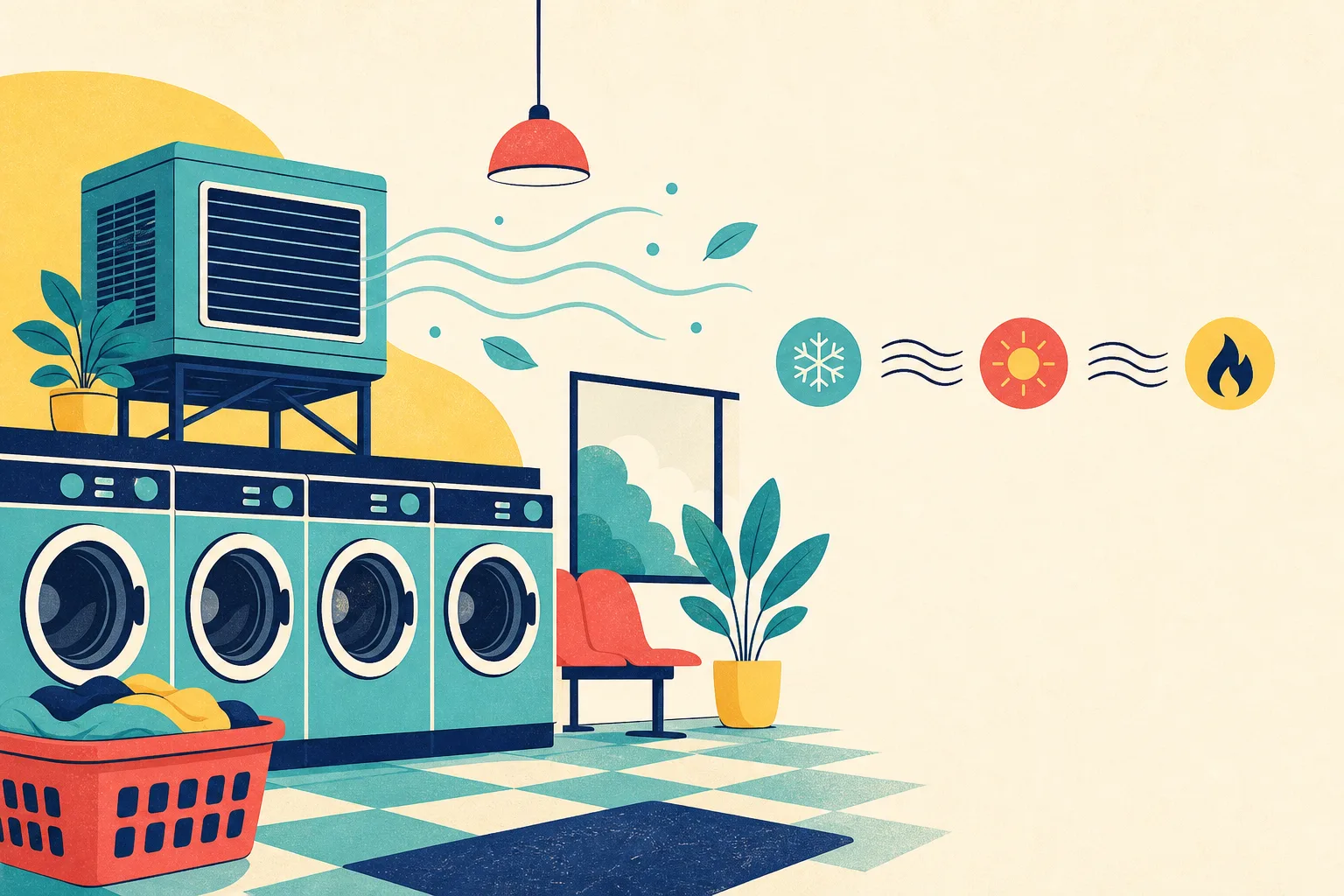
In certain regions of our country with consistent and moderate climates, swamp coolers are the predominant selection because of their lower operating costs. Higher humility limits the cooling benefit of swamp coolers so in humid settings the primary benefit is the movement of air by the fans included in the swamp coolers. Swamp coolers stream water over a filter by means of a pump and pass a volume of air, a high-speed fan, over this wet filter to provide a cooling benefit. Yearly inspection of the pumps and fans of swamp coolers are required to clean and ensure proper operation. The only cost is the electricity used to power the motor driving the fans. The automatic operation of these units guided by an internal thermostat make these units management free and an economic option.
The use of heating units is seen in cold weather regions and issues of installation, cost and savings are minimal compared to cooling issues. Very often heating and cooling features are contained in the same unit.
**• How long will a laundry’s HVAC unit last? What factors affect this? **HVAC appliances have a traditional expectation of long life. Somewhere in the 10-to-25-year range is normal. Swamp cooler pumps average about three to five years and entire units from five to fifteen years. Keeping the units maintained and serviced on a regular basis extends life and ensures proper operation.
A faded or slightly rusted look of the exterior of a swamp unit does not signal the end of useful life. They can be painted with Rustoleum type paint and the water pan sealed with Home Depot purchased pan sealing products. Only when the pan (floor where water pools) is rusted beyond patching and repair is your swamp cooler ready for replacement.
**• What are the key maintenance tips, as well as some top trouble-shooting strategies? A yearly visit to the roof of your building where you observe roof conditions should also include an inspection of your vents, swamp coolers and HVAC units. **Frayed belts, rust spots and clogged filters should be addressed. Older units might have a grease or oil fitting. With air conditioning check your Freon level before the summer heat arrives.
**• Where and how should an HVAC unit be situated within a laundry setting? Why? Interior vent placement is going to be somewhat limited because of the need for proper roof top placement. Intake for your cooling/heating units must be located away from the dryer exhaust vents to minimize lint being drawn into the filters of your unit. The units must compete with the placement of air intake vents for the oxygen needed for heater and dryer combustion. Interior vents can be directed to preferred locations by interior venting, but long runs of swamp cooler venting may lose some of their volume and effectiveness. Down draft swamp coolers with four directional registers are frequently installed in Laundromats. **The best location for venting registers is above your folding tables. Customers spend more time standing at folding than any other place during their visit to your Laundromat.
**• How critical is the ductwork? **Ductwork, on non-downdraft units, can be flexible round ducting (insulated or non-insulated) or fixed metal ducting. Flexible ducting may be more likely to require periodic cleaning because of the irregular interior caused by the flexibility.
**• What, if any, are the special considerations for HVAC units in Laundromat settings? One of the best locations for the placement of air conditioning in Laundromats is on the ground level to avoid the drawing in of lint from rooftop locations. Although in higher crime areas this may not be the best choice since the theft of copper from your unit is made easier. In high humidity locations (areas with lots of plants and foliage in the area) swamp coolers are less effective. Swamp cooler work best in low humidity, high temperature climates. **Early in the 20th century swamp coolers were used throughout Arizona and other desert locales, but their contribution to cooling has been greatly reduced by the higher humidity brought on by increased plantings.
**• How can laundry owners best increase their efficiency with regard to air conditioning and heating? Keeping the filters clean, and without holes, increases unit efficiency. Setting the temperature at 78 to 80 degrees for air-conditioned stores can reduce costs of operation. **The shade of tall trees surrounding your Laundromat does help cool your interior and reduces stress on your cooling unit. It’s a great idea to plant a few trees to shade your air conditioner at your Laundromat or your home.
**• What factors go into sizing an HVAC unit for a vended laundry? The sizing of HVAC units is governed by the plumbing code and local regulations. When you are faced with an option, error on the side of a little more capacity. **The size of the venting must be matched to the size of an air conditioning unit or back pressure will reduce efficiency and can lead to early unit failure.
**• Why is sizing so critical? **To put it in Laundromat terms, you need enough dryer capacity to handle your washer capacity or you’ll have unhappy customers. The same is true with heating and cooling. You need enough capacity to generate an environment that will lead to happy customers.
**• What types of costs can laundry owners expect to pay for HVAC systems? HVAC units pricing is subject to size required, time of year purchased, ability of the buyer to research brands and effort spent in negotiate with various vendors. **The best time to repair or replace air conditioning is not during the summer months. Too much demand means higher prices for installation and repair.
**• What are the current trends in HVAC equipment? To achieve energy savings, many owners are using white on their roofs, wind driven turbine ventilators, ceiling insulation and careful isolation of the back of dryers to prevent mingling of cooler air with dryer intake air. Regarding swamp coolers, there have been no significant advances in at least twenty years, besides having them available with non-rusting fiberglass cabinets. **Shading of air conditioning units from the direct heat of the sun helps reduce heat buildup. There have been no significant changes in air conditioning units for a number of years.
**• Is there any recent “green” technology that store owners should know about? Despite a few claims to the contrary, there are no green technologies that have made any significant impact on HVAC for Laundromats. **Nest thermostats are great for home use, but are subject to theft if placed at their proper operational height in Laundromats.
**• What common mistakes should owners avoid with regard to their HVAC systems? Ignoring maintenance on HVAC units is the most common mistake made by Laundromat owners. When the units are located on rooftops, it’s “out of sight, out of mind.” **Maintenance should be done yearly, not when your units fail to operate. Ignoring a problem doesn’t make it go away. Customers deserve a clean and comfortable environment to wash, dry and fold their clothes.